
Industrial gas solutions for glass manufacturing
Explore how Linde supports efficient, high-quality glass manufacturing with industrial gases and expert services.
Linde's pioneering technologies have transformed the glassmaking industry, helping producers cut fuel use, lower emissions, and reduce costs - setting modern standards for an age-old craft.

In September 2024, Linde Senior Corporate Fellow Hisashi 'Sho' Kobayashi received a Lifetime Achievement Award at the Glass Problems Conference in Toledo, Ohio, honoring his lasting contributions to the glass industry. Celebrated for his role in developing and implementing energy-saving technologies, Dr. Kobayashi is quick to credit the Linde teams behind the breakthroughs.
From pioneering Oxyfuel melting to waste heat recovery and specialized oxygen supply systems, Linde's innovations have for decades helped glassmakers improve quality, boost productivity, cut costs, reduce fuel use, and lower emissions. In fact, look closely at the glass industry today and you'll find Linde's fingerprints all over it.

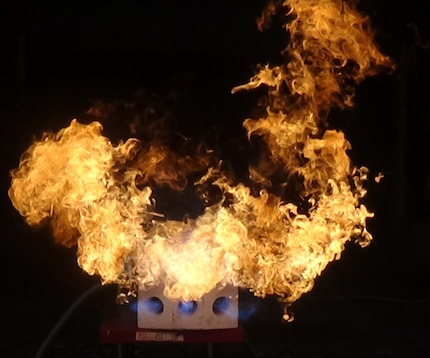
To understand the first step-change in glass production one must understand the impact of Oxyfuel combustion. Oxyfuel combustion replaces ordinary air with pure oxygen, eliminating the nitrogen that normally dilutes and cools the flame. Once that buffer is gone, the reaction becomes far more intense. "Early oxyfuel flames behaved almost like a blowtorch," explains Shrikar Chakravarti, Global Director for Glass at Linde. "Less fuel is required, but the flame becomes extremely hot and focused." The challenge was to harness that power, shaping it into a flame that delivered oxyfuel's efficiency while still providing the uniformity and control of an air flame. Achieving the quality, productivity and emission targets that customers require would take more than just swapping out the fuel.
On the back of decades of development, the 1990s saw Linde launch the world's first oxygen-staged combustion burner for glass furnaces - specifically designed to minimize NOx emissions. Which it did: by 80-90% versus conventional non-staged oxyfuel burners. Linde also pioneered the successful conversion of the first large container glass furnace from air-fuel to oxyfuel melting. "Over the years, our OPTIFIRE® burner portfolio has continued to evolve based on customers' needs and challenges. We listen and then we innovate to find the best solution," explains Chakravarti.
The OPTIFIRE® Wide Flame Burner (WFB) was introduced to provide a wide flame (thus fewer burners required) with low momentum that reduced particulate emissions and crown corrosion. More recently, in response to specific customer requests to mitigate condensate build-up on burners ports and to reduce foam on glass melting surface, Linde developed the OPTIFIRETM XD Burner and the OPTIFIRETM FLEX Burner respectively - each now successfully deployed in both traditional oxyfuel and hybrid oxyfuel furnaces.

Accounting for more than 80% of the total energy share of the glass production process, reducing the fuel consumption of the glass melting process is the most impactful way for glass companies to minimize CO2 emissions in their operations. Several glass companies have stated targets of 20 – 30% reduction by 2030 and carbon neutrality by 2050.
Spotting potential early, efficiency has been the focus of development efforts at Linde for more than twenty years - with the patented OPTIMELTTM Thermochemical Regenerator (TCR) system for waste heat recovery the key resulting innovation.
"This breakthrough technology is based on a unique waste heat recovery concept using endothermic chemical reactions," explains Chakravarti. "By recovering heat stored in a regenerator checker during the flue gas exhausting cycle, we can achieve a net reduction in energy consumption of up to 30%". Importantly, there's a corresponding reduction in fuel-based Scope 1 CO2 emissions.
OPTIMELT TCR is already helping glass customers curb fossil fuel consumption. The first OPTIMELT TCR system was installed on Pavisa's 50 t/d container glass furnace in Mexico in 2014, followed by Libbey’s (now Leerdam Crisal Glass) high quality tableware furnace in Leerdam, Netherlands in 2017. "Linde's OPTIMELTTM technology is helping us and the broader glass community take meaningful steps towards decarbonizing the energy-intensive melting process," states Marco Van Valberg, Director Sustainable Manufacturing at Leerdam Crisal Glass. The Technology team is currently starting up the third OPTIMELT system at O-I Glass' (largest container glass company in the world) furnace in Holzminden, Germany.

Looking to tomorrow, the OPTIMELT TCR technology is green-fuel ready. That is to say it is fully compatible with the likes of hydrogen, ammonia and bio-ethanol as well as their blends with natural gas. Thus, companies investing in an OPTIMELT system today can achieve their near-term goals of up to 30% reduction in CO2 emissions, while making them future-ready for carbon neutrality when green fuels become economically viable.
Beyond burners and waste heat recovery, Linde is also reshaping oxygen supply for the glass industry by replacing costly high-pressure, ultra-high-purity oxygen from cryogenic air separation units with its advanced VITRONTM Vacuum Pressure Swing Adsorption (VPSA) on-site systems. Such innovations dramatically reduce the energy required to produce oxygen.
"We have developed a patented technology that is quieter, more compact and easier to maintain, lowering both operating and capital costs for customers while delivering high reliability and on-site liquid backup from Linde's extensive plant network," notes Brian Bodkin, Global Director of Small On-Site Systems at Linde.

"Crucially, Linde has the capability to combine its leading oxygen production capabilities with its expertise in glass applications to offer a fully integrated oxyfuel solution," he adds. The OPTIFLO2TM approach pairs the VITRONTM VPSA plant with a customized oxyfuel combustion system including OPTIFIRE® burners, eliminating the need for product oxygen compression and resulting in significant savings in upfront investment as well as power costs over the furnace campaign.
On top of the leading equipment, technologies and gases, Linde's OXYSERVICETM offerings cater to a range of customer challenges and help further improve process efficiency. "Whether it's increasing pull rate, extending furnace campaign or repair without production loss, we have our customers covered" says Chakravarti.
When it comes to the glass industry, one thing quickly becomes glaringly transparent: Linde has the expertise and innovation potential to work with its customers to lead glassmaking into the future.
Explore how Linde supports efficient, high-quality glass manufacturing with industrial gases and expert services.

Discover how Linde helps reduce CO2 emissions and advance sustainability across glass production.
Learn how Linde's equipment and technologies enhance performance and reliability in glass manufacturing.