CRYOLINE® RC The Full Crust Freezing Solution - Without The Trimmings.
As demand for sliced meat products grows, Linde's CRYOLINE® RC Rapid Crust Freezer shows how cryogenic crust-freezing can help processors protect yield, reduce waste and achieve more consistent slicing quality.
CRYOLINE® RC in Action
Helsingborg, Sweden, October 6-8
Join us at the Linde Food Center in Helsingborg, Sweden, from October 6-8 and experience rapid crust freezing technology live.
For meat processing companies, slicing quality alone can mean the difference between prime-cut, beautifully marbled, rib-eye steaks selling at €50 per kg and … dog food. Any so-called "out of spec" product - be it irregular thickness or rough edges - are rejected. Likewise, in the case of cooked or processed deli meats like bologna, mortadella and other luncheon favorites, slices deemed to fall short of "stackability" standards will be discarded rather than destined for the deli. This way, aesthetic quality can be upheld, but it comes at a price: lower yield.
Crust-Freezing: The One Way to Cut Waste"
At industrial scale, slicing machines can be operating at anything up to 2,000 slices per minute," explains Istvan Molnar, Associate Director of Commercialization for Food, Europe at Linde. The faster the operation, the more "trimmings" or "fines" are produced during the slicing. "These small shavings of meat may not seem like much when caked to the inside of the slicing machine, but this waste also scales up." It is waste that, along with out-of-spec product, customers all too easily write off - with significant impact on yield and profitability.
While development of slicing technology continues, Crust Freezing - where the thin outer layer of the meat product to be sliced is frozen firm - is the industry's go-to for improving quality and yield off any given slicing machine. But as Molnar claims: "Mechanical crust freezing is better than no crust freezing. But cryogenic crust freezing brings even more business benefits" Linde's powerful and flexible CRYOLINE® RC Rapid Crust Freezer now offers an innovative way of enhancing crust consistency while significantly improving slicing yield.
Mechanical vs Cryogenic Crust Freezing
Mechanical or central crust freezing typically requires a production setup with a central freezing room: already occupying a large site footprint and significant labor. Logs are crust frozen overnight before being taken to slicing machines the next day leaving little room for flexibility in operations. What's more, "the product tends to sit and wait to be sliced and portioned," explains Molnar, "which can affect quality and yield since uneven crust retention will occur." That is to say, if a number of batches are taken out of the freezer and queued up for the slicer, the first batch might be over frozen, the next will be just right and the last batch - by the time it gets its turn - will already have started to thaw. This is where the product loss tends to occur: through tears, crumbling and miscuts.
"The trolleys also need to be manually transported which means significant labor costs" says Molnar, "and the limited directionality of the airflow makes even and consistent 360° freezing practically impossible." Bottom line: quality is compromised, as well as production line flexibility and efficiency.
Cryogenic Crust Freezing, on the other hand, uses cryogenic gases at much lower temperatures to rapidly freeze product without the need for a central freezer. "We can help companies save labor, space and time," adds Molnar.
Unfortunately, embedded videos are unavailable at this time.
CRYOLINE® RC: Linde's All-Around Innovation
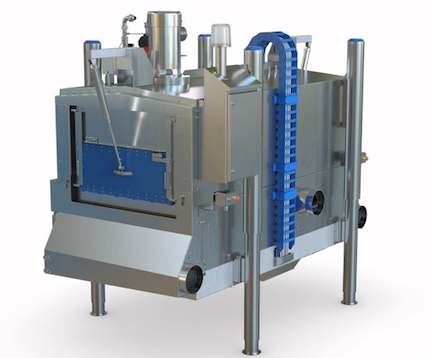
The first thing to notice about the freezer itself is the minimal footprint. "The compact design is made possible through our patent-pending technology that combines innovative gas flow with the power of cryogenic freezing," explains Molnar. Optimized use of liquid nitrogen means the CRYOLINE RC delivers up to 300% heat transfer rate of general-use cryogenic tunnel freezers. The result: a 360° uniform all around crust, reducing the risk of tears, crumbling and miscuts and preserving product quality. "One test with a food customer showed that all things being equal, crust freezing a meat log (3100 g) using the CRYOLINE RC (compared to no crust freezing) reduced the percentage losses per weight from 8,1% to 3,7%." The same test showed that trimmings on the slicer side wall reduced from 50g to 15g and slice rejections went from twelve to zero. In addition, the size of the cut-off end piece was significantly reduced in all cases.
Do you want to know more?
One of our experts would be delighted to discuss your needs, answer your questions and provide more detailed information.
But the benefits of CRYOLINE RC go beyond the output of the unit itself - to their placement in production. "These semi-batch crust freezers support just-in-time automated operations," he adds, "which means they can be positioned directly before the slicer." This not only offers distinct advantages over mechanical crust freezing like reduced manual product handling and related food safety risk reduction, but such rapid freezing lends itself to flexible operations too: "Customers can react to changing sales demands immediately without factoring in overnight freezing time."
The Sliced Meat Market: From Consumer to Customer to Linde.
As the leader in developing new technology offerings to the food freezing and chilling industry, Linde has over 300 active patents. "This speaks to our commitment to R&D," says Molnar, "which is driven by an in-depth understanding of customer needs." That is to say, the CRYOLINE RC was developed and added to the existing CRYOLINE family because it solves specific customer challenges - which are themselves driven by consumer trends.
"Meat portioning companies are responding to the demand for portioned products, driven by consumer behaviors that prioritize convenience over preparation and a shift to charcuterie culture," says Molnar. Indeed, across the market, meat consumption is becoming less about preparing large cuts and more about using protein quickly and flexibly which means the market for ready-to-eat and pre-sliced meat formats is growing steadily. According to market intelligence reports, the global deli meat market was $207.86B in 2025, forecast to reach $271.6B by 2031 (4.56% CAGR)."As buyers upgrade expectations and margins tighten, processors operating high-capacity slicing lines cannot afford yield loss or inconsistent slicing," adds Molnar.
Luckily, the CRYOLINE RC Rapid Crust Freezer has come along just in time.