
Controlled Furnace Atmospheres
Enhance process stability, precision and controllability in annealing, hardening, carburizing, nitriding, brazing and more

Gases, along with temperature and time, play a key role in ensuring the stability and controllability of heat treatment processes. Building on the experience we have gained in the successful delivery of countless heat treatment projects worldwide, we can help you fine-tune the gas atmosphere in contact with your workpiece - whether you operate a batch furnace, continuous furnace or vacuum furnace. We complement our comprehensive range of process gases with gas control, injection and analysis technologies plus service, support and advice to help you achieve the best outcomes. Our expertise spans controlled furnace atmospheres, vacuum and sub-zero processes as well as powder metallurgy.
Our core competencies in heat treatment include:
Enhance process stability, precision and controllability in annealing, hardening, carburizing, nitriding, brazing and more
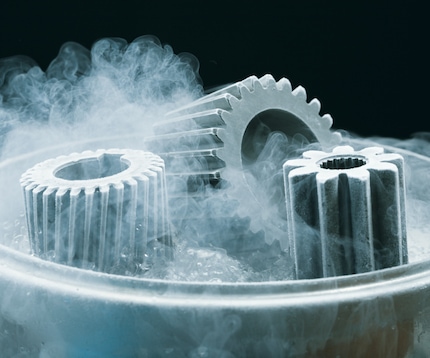
Improve material properties and extend the lifetime of heat-treated parts with our cryogenic treatments
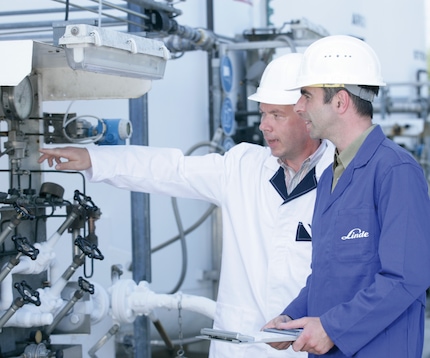
Click to explore the benefits of a single source for all your gas installation, supply, service and support needs in heat treatment
Heat treatment involves subjecting a metallic material or component in the solid state to a controlled thermal cycle. This controlled thermal treatment involves heating, holding at an elevated temperature (soaking), and then cooling. Heat treatment may be carried out in one or more heating and cooling cycles.
These treatments are performed to effect certain microstructural changes in a material. These changes, in turn, result in desirable mechanical and physical properties. In short, heat treatment is used to modify, restore or enhance the properties of metals and alloys.
Industrial heat treatment can entail simple, relatively low-temperature treatments to help heat treatment operators achieve high-quality welds in components and to relieve the stresses locked into the structure from previous forming or welding operations. However, heat treatment can also involve complicated higher-temperature processes to give specific levels of mechanical properties after fabrication of the components is complete. Certain post-treatment steps may also be necessary to remove heat treatment defects.
There are many different heat treatment processes. Some of these are carried out in different heat treatment furnace types, such as heat treatment nitriding furnaces or carburizing furnaces.
Solution treatment involves the heating of a component to a high temperature in order to dissolve second-phase particles and compounds present in the microstructure into solid solution. The alloy is heated to a sufficiently high temperature so that elements or compounds present in the microstructure are taken into 'solid solution'. Quenching, in other words, rapid cooling from high temperatures, is used to retain these elements or compounds in solution. Frequently, an age hardening treatment is used after solution treatment to re-harden the alloy microstructure in a controlled manner.
Powder processes commonly used in heat treatment include atomization, powder metallurgy sintering, and hot isostatic pressing (HIP). Like most heat treatment processes, industrial gases are essential for these powder metallurgy treatments.
The parent material close to a weld often undergoes some changes during welding. To control these effects and improve the properties of the welded joint and the surrounding material after welding, heat treatment may be applied at three distinct stages, namely preheating, interpass temperature control and post-weld heat treatment (PWHT). The final PWHT step may simply extend the preheat and interpass temperature to the completed weld, or it may be an elevated temperature treatment designed to relieve residual stresses or to bring about certain metallurgical changes across the whole weldment.