
Acetylene Fuel Gas
Increase productivity in metal fabrication and other applications with acetylene - the hottest and most efficient of all the fuel gases

The term fuel gases refers to gases that can be burned to generate a flame and/or heat. They include acetylene, hydrogen, natural gas, propane and propylene.
Most fuel gases are composed in whole or in part of hydrocarbons (methane, acetylene, propane and propylene), hydrogen, carbon monoxide and oil vapors. Each fuel gas has a different ratio of carbon to hydrogen atoms, which means that different amounts of oxygen are needed to burn the gas efficiently.
This ratio of fuel to oxidant and the molecular structure affect the temperature of the flame, as well as the flammability and explosive limits.
Fuel gases can be stored either as a compressed gas or as a liquid, depending on the gas type and on the amount of product required. Some gases such as acetylene have to be stored in a very specific way, in this case in a cylinder filled with a porous mass soaked in acetone.
Visit your local site to find which fuel gases from Linde are available in your region.
Fuel gases are used across an extremely broad application spectrum. Many metal fabrication steps, including cutting and welding, flame heating processes and heat treatment, rely on fuel gases. Most metal heating applications require rapid and concentrated heat input into a given area. An oxy-fuel gas flame provides the hottest flame and heat intensity for these use cases. The oxidant can be supplied from oxygen cylinders or a bulk source. Lower-temperature applications that can be heated slowly over a longer period of time can use alternative air-fuel gas systems. Here the air is provided from cylinders, a compressed air supply source, or air induced into the torch by the action of higher-pressure fuel gas. Our experts have many decades of experience in the use of fuel gases for welding, cutting and other metal fabrication applications. Not only do we supply the full range of compressed fuel gases in cylinders, we can also help you optimize the flame temperature and oxygen jet, and advise on the appropriate safety precautions. In addition, we offer the full range of welding and cutting equipment.
Fuel gases are also commonly used as a source of power and energy for transportation, with the potential to reduce the environmental impact - and emissions in particular - of a growing number of road vehicles. Natural gas and liquefied natural gas are seen by many industry experts as an increasingly valuable bridge towards a lower-carbon, renewable-rich landscape. With a new wave of LNG projects currently in the pipeline, our gas processing, liquefaction and storage expertise is proving an invaluable asset. Hydrogen too is helping to power the transition to a greener economy - reaching beyond cars and trucks to innovative rail and maritime applications. As a global leader in the production, processing, storage and distribution of hydrogen, we have the largest liquid hydrogen capacity and distribution network in the world.
Looking beyond metal fabrication and transportation, fuel gases are also at the heart of many industrial processes. Industries such as steel, non-ferrous metals, glass, concrete, and pulp and paper rely on the high temperatures and rapid heating capabilities of fuel gases - often enriched with oxygen - to provide combustion and process heating in furnaces, kilns, boilers, reactors and similar. The benefits of an oxygen-enriched environment include higher temperatures, enhanced combustion efficiency and the reduction or elimination of harmful emissions.
Natural gas and hydrogen are suited to transportation options. The choice for metal fabrication and combustion applications is wider, depending on the specific application and heating requirements. Because each fuel gas has a different ratio of carbon atoms to hydrogen atoms, different amounts of oxygen are needed to burn the fuel gas efficiently. This ratio of fuel to oxidant affects the temperature of the flame, the flammability and explosive limits. Some of the differentiating features and benefits of fuel gases - especially for heat treatment, flame and melting applications - are summarized in the following.
| Properties | Acetylene | Propane | Propylene | Methane | Hydrogen |
|---|---|---|---|---|---|
| Chemical formula | C2H2 | C3H8 | C3H6 | CH4 | H2 |
| Color | Colorless | Colorless | Colorless | Colorless | Colorless |
| Odor | Garlic odor | Fishy odor | Fishy odor | Odorless | Odorless |
| Density of gas in kg/m³ (15°C, 1 atm) | 1.109 | 1.82 - 1.88 | 1.875 | 0.676 | 0.0899 |
| Specific gravity (Air = 1) | 0.905 | 1.40 - 1.60 | 1.48 | 0.55 | 0.070 |
| Volume of gas per volume of storage | 220 | 275 | 287 | † | † |
| Vapor pressure in bar(g) at 20°C | -- | 8.3 | 10.2 | -- | -- |
| Auto ignition temp (°C) | 305 (air) 206 (O2) |
480 (air) 470 (O2) |
460 (air) | 580 (air) 555 (O2) |
572 (air) 560 (O2) |
| Flammability range in air (% by vol.) | 2.2 to 80-85 (Up to 100% of source) |
2.2 to 9.5 | 2.0 to 10.5 | 5.3 to 15 | 4 to 75 |
| Flammability range in oxygen (% by vol.) | 2.8 to 93 (if ignition is strong) |
2.3 to 45 | 2.1 to 53 | 5 to 60 | 4 to 95 |
| Maximum flame temperature in air (°C) / Ratio of air/fuel required | 2590 / 4.92 | 1980 / 18.1-23.8 | 2054 / 15.7-19.0 | 1960 / n/a | 2373 / n/a |
| Normal flame temperature in O2 (°C) / Ratio of O2/fuel required | 3106 / 1.1 | 2810 / 3.75 | 2872 / 3.1 | 2770 / 1.6 | 2834 / 0.36 |
| Maximum flame temperature in O2 (°C) / Ratio of O2/fuel required | 3160 / 1.5 | 2828 / 4.3 | 2896 / 3.7 | 2786 / 1.8 | 2856 / 0.42 |
| Flame speed m/s in air | 2.80 | 0.82 | n/a | 0.67 | 4.88 |
| Flame speed m/s in O2 | 7.4 | 3.3 | 3.8 | 3.0 | 9.0 - 11.0 |
| Heat intensity MJ/m2/s | 61.0 | 34.0 | 36.0 | 23.0 | n/a |
| Calorific values (kJ/m3) | 54772 | 95758 | 88000 | 37260 | 12108.5 |
| Heat distribution (kJ/m3) 1) Primary flame 2) Secondary flame |
18890 35882 |
10433 85325 |
16000 72000 |
1490 35770 |
-- -- |
Increase productivity in metal fabrication and other applications with acetylene - the hottest and most efficient of all the fuel gases
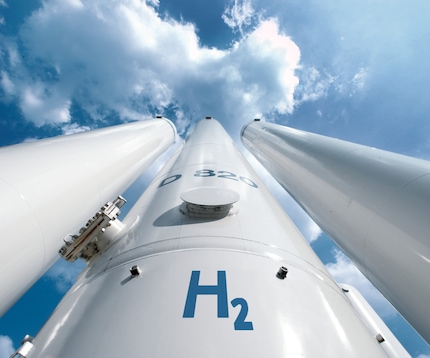
Combine high pressure with rapid heating and precise process control for your heating, cutting and combustion tasks - with hydrogen

Enjoy fast, controllable heating and high energy density across countless industrial, metal fabrication and heating applications
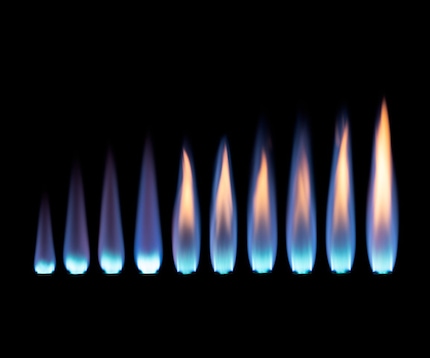
Discover how high combustion heat and flame temperature plus high vapor pressure make propylene ideal for high-velocity spraying and more
Visit your local site and connect with one of our experts to talk through the products and services available in your region